Dubai Property Outlook 2026: Why 69% of Investors Expect Prices to Rise
Explore why 69% of investors expect Dubai property prices to rise in 2026, the factors driving demand and what buyers should consider before investing.
Dubai Property Outlook 2026: Why 69% of Investors Expect Prices to Keep Rising
Dubai’s property market entered 2026 with a difficult act to follow. After several years of rising prices, record transaction activity and strong international demand, the market was no longer being compared with an ordinary baseline. It was being measured against some of its own best-performing periods.
Yet investor confidence has remained remarkably firm.
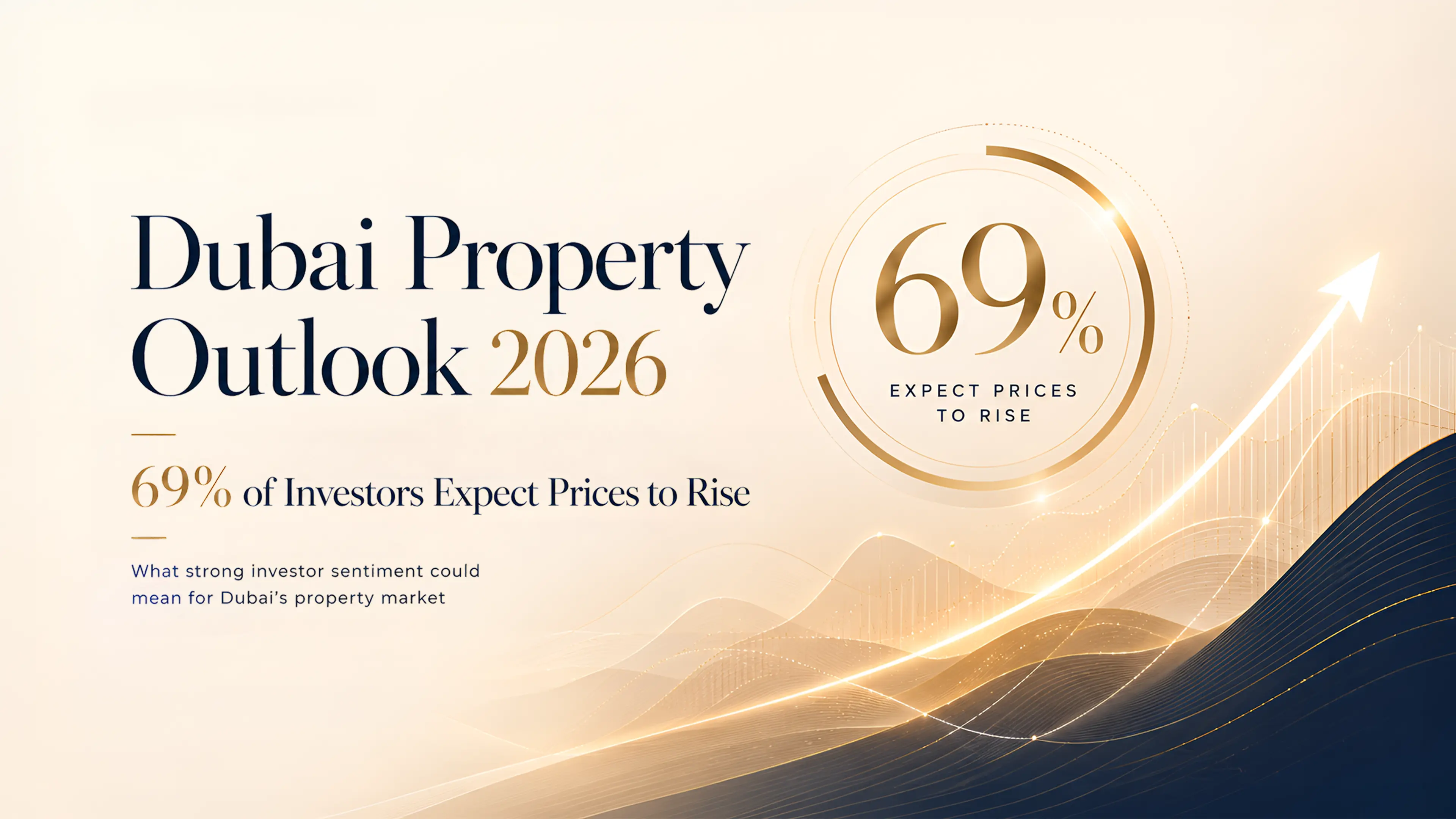
A new investor-sentiment study by real estate investment platform Stake found that 69% of more than 5,000 participants expect Dubai property prices to rise during 2026 . Almost half of those surveyed also believe transaction volumes could exceed the levels recorded in the first quarter, despite Q1 already setting a demanding benchmark for the rest of the year.
That optimism does not mean every property will appreciate at the same pace, nor does it remove the need for careful research. What it does show is that many investors continue to see Dubai as a market supported by long-term demand, expanding infrastructure, global capital and a growing resident population.
So, what is behind this confidence, and what should buyers watch before making a decision?
Investor Sentiment Remains Strong After a Record First Quarter
The timing of the survey is important. Investors were not being asked for their expectations after a weak opening quarter or a broad market slowdown. They were responding after Dubai had already recorded AED 252 billion in real estate transactions during Q1 2026 , representing a 31% year-on-year increase in value.
Dubai Land Department data shows that the quarter included 60,303 property transactions , up 6% from the same period in 2025. Real estate investments reached AED 173 billion across 57,744 investments , while the total number of investors increased to 48,448.
Of these, 29,312 were new investors, demonstrating that fresh capital continues to enter the market rather than activity being driven only by existing owners.
Against that background, the belief among 69% of survey participants that prices may rise further becomes more meaningful. It suggests confidence is not based solely on a rebound from a low point. Investors appear to believe that the foundations behind Dubai’s recent performance can continue supporting the market, even after a strong run.
Why Investors Still See Room for Growth
Dubai’s appeal has gradually moved beyond the traditional image of a short-term, speculation-led property market. Many buyers now view the city as a long-term base for residence, business, wealth preservation and portfolio diversification.
The emirate’s broader economic direction plays a major role in that shift. Dubai’s D33 Economic Agenda aims to double the size of the economy by 2033 and place the city among the world’s leading destinations for living, investment and business.
This ambition is supported by continued development across transport, aviation, commercial districts, tourism infrastructure and new residential communities.
The Dubai Real Estate Sector Strategy 2033 also sets specific objectives for the property market. These include increasing real estate transactions by 70%, raising the market’s value to AED 1 trillion, lifting homeownership to 33% and approximately doubling the sector’s contribution to Dubai’s GDP to AED 73 billion.
These targets do not guarantee uninterrupted price growth. They do, however, provide a clearer long-term framework for the sector. Investors can see where the city intends to expand, how ownership is being encouraged and why real estate remains closely connected to Dubai’s wider economic plans.
A Growing Population Is Creating Real Housing Demand
Property prices become more sustainable when demand is supported by people who need homes, rather than only investors trading assets between themselves.
Dubai’s population was estimated at approximately 4.25 million residents at the end of 2024 , according to the Dubai Data and Statistics Establishment. The city’s active daytime population was significantly higher when temporary residents and workers living outside the emirate were included.
More residents create demand across several parts of the housing market. Professionals require well-connected apartments near employment centres. Families look for schools, parks, larger layouts and community facilities. Entrepreneurs and business owners often seek central or premium addresses, while wealthy international buyers continue to consider waterfront villas, branded residences and trophy homes.
This diversity matters. Dubai is not dependent on one buyer profile or one property category. Demand can move between affordable apartments, mid-market communities, family villas, luxury homes and income-producing assets depending on economic conditions and buyer priorities.
Off-Plan Property Continues to Dominate Residential Sales
One of the clearest features of the current market is the strength of off-plan sales. Recent ValuStrat figures cited in the report show that off-plan properties accounted for around 75% of residential transactions .
Monthly off-plan activity rose by 32%, although transaction volumes were 16% lower than the corresponding period a year earlier. Ready-property transactions increased by 46.8% month on month, the strongest monthly rise in three years, but remained 23% lower year on year.
These comparisons reveal a more detailed picture than a single headline can provide. Buyer activity improved sharply from the previous month, while annual volumes softened from unusually strong earlier levels.
That does not necessarily indicate a weak market. It may suggest that buyers are becoming more selective as prices rise and more supply is launched.
Off-plan property remains attractive because it can offer lower initial capital requirements, staged payment plans, new amenities and access to emerging communities before they are fully established. However, the popularity of off-plan sales makes project selection increasingly important.
Buyers should look beyond launch-day excitement and assess the developer’s record, construction progress, escrow arrangements, location fundamentals, payment obligations and expected supply at handover. A strong market cannot compensate for a poorly selected project.
Luxury Property Remains a Major Pillar
Dubai’s luxury segment continues to attract significant attention from international investors and high-net-worth buyers.
Dubai Land Department reported AED 87.71 billion in luxury real estate investment during Q1 2026 , a 26% increase. Foreign investment across the wider property market reached AED 148.35 billion, also rising by 26%, reinforcing the city’s position as an international destination for property capital.
The Stake investor study found that 61% of participants expect luxury property activity to remain at or above the level recorded in the first quarter .
Several factors continue to support this segment. Dubai offers a growing collection of waterfront homes, branded residences, private-island communities, golf estates and limited-edition developments.
It also provides a lifestyle proposition built around safety, connectivity, international schools, hospitality, business access and high-quality services.
Scarcity remains particularly relevant at the top end of the market. New luxury supply may be substantial in overall numbers, but genuinely rare assets—such as well-positioned beachfront villas, large plots, signature penthouses and homes in tightly held communities—cannot be reproduced easily.
This can help protect demand for the best properties even when buyers become more selective elsewhere.
Will Every Dubai Property Rise in Value?
No market moves evenly, and Dubai is becoming increasingly segmented.
Two properties launched at similar prices can deliver very different results depending on location, view, layout, developer quality, service charges, future supply and the owner’s entry price.
A project may perform well at launch but face heavy competition when several nearby buildings are handed over. Another may appear expensive initially but benefit from limited supply, stronger rental demand or major infrastructure improvements.
The expectation that Dubai prices may rise in 2026 should therefore not be interpreted as a signal to buy anything available. Broad market confidence is useful, but individual asset quality remains decisive.
Established communities may appeal to investors seeking current rental income and visible transaction evidence. Emerging districts may offer stronger appreciation potential but require patience and a greater tolerance for construction and delivery risk.
Luxury buyers may prioritise scarcity and lifestyle, while yield-focused investors may prefer compact units in areas with deep tenant demand.
The right choice depends on the investor’s objective, budget, holding period and risk profile.
What Could Slow the Market?
A balanced outlook must consider the risks as carefully as the opportunities.
Dubai has a large pipeline of new residential supply. As more projects reach completion, certain locations could experience greater competition between landlords and sellers.
This may place pressure on rents, resale prices or absorption rates, particularly where projects offer similar products without clear differentiation.
Affordability is another consideration. After several years of growth, buyers are more sensitive to price per square foot, payment-plan structures and total acquisition costs.
Higher entry prices can reduce future upside if the property is purchased substantially above comparable market value.
Global economic uncertainty, financing costs and currency movements can also influence international demand. Dubai attracts capital from many regions, which provides diversification, but it also means external conditions can affect buyer behaviour.
None of these factors automatically points to a major correction. They simply underline the importance of disciplined selection. Investors should test assumptions rather than rely on market enthusiasm alone.
What Smart Investors Should Focus on in 2026
The strongest opportunities are likely to be found where genuine demand meets sensible pricing.
Location remains essential, but the definition of a good location is changing as Dubai expands. Proximity to established business districts is valuable, yet future transport links, employment hubs, schools, airports and lifestyle destinations can also create long-term demand in newer corridors.
Investors should compare the property’s price per square foot with completed and recently sold alternatives, not only with other units in the same launch. They should study the supply expected before and around handover, evaluate realistic rents and calculate all ownership costs.
For off-plan purchases, the payment plan should match the buyer’s cash flow without depending on an uncertain resale before completion.
For ready properties, building quality, maintenance, occupancy, service charges and achievable rental income deserve close attention.
It is also worth separating an attractive property from an attractive investment. A beautiful home may not produce the strongest yield, while a less dramatic unit in a highly liquid rental market may deliver more consistent returns.
The best decision is the one aligned with the buyer’s actual goal.
Confidence Is High, but Selection Will Define Performance
The latest investor survey sends a clear message: confidence in Dubai property remains strong in 2026.
With 69% of participants expecting further price growth and 49% anticipating higher transaction volumes than the already exceptional first quarter, investors are not yet viewing the market’s momentum as exhausted.
Official data supports the view that demand remains broad. Transaction values, investment volumes, luxury activity, foreign capital and the number of new investors all recorded growth in Q1.
Still, the next stage of Dubai’s property cycle is likely to reward research more than urgency. As the market matures and supply expands, performance will depend increasingly on the quality of the asset, the credibility of the developer, the strength of the location and the price paid.
Dubai may continue to rise, but the gap between the best and weakest investments could become wider. For buyers, that makes informed advice, detailed comparison and a clear investment strategy more valuable than ever.
Planning to Invest in Dubai Property?
NUVÉ Properties helps buyers compare communities, developers, payment plans, rental potential and long-term growth prospects across Dubai’s ready and off-plan markets.
Speak with our team to identify opportunities aligned with your budget, timeline and investment goals.
Disclaimer: This article is provided for general information only and does not constitute financial, legal or investment advice. Property values, rental returns, completion dates and market conditions can change. Buyers should conduct independent due diligence and obtain professional advice before entering a transaction.