Dubai Tokenised Real Estate Starts from AED 1,000
Dubai has lowered the entry point for tokenised real estate resale investments to AED 1,000. Discover how it works, its benefits, risks and what investors should check.
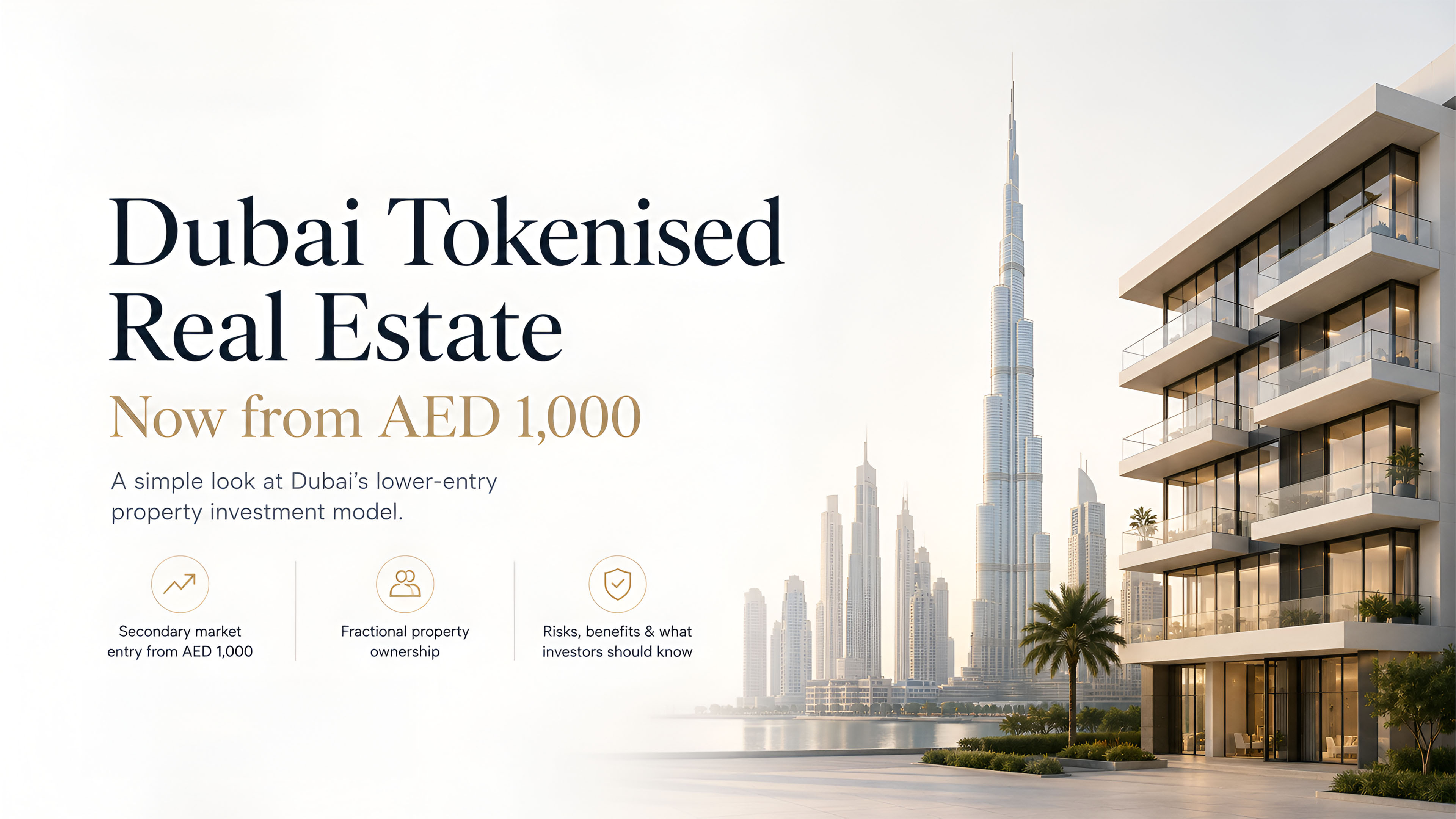
Dubai Tokenised Real Estate Now Starts from AED 1,000: What Investors Need to Know
Dubai has taken another important step towards making property investment more accessible. PRYPCO MINT has reduced the minimum amount required to purchase existing tokenised property shares through its secondary marketplace from AED 2,000 to AED 1,000.
The change does not apply to every investment offered on the platform. New tokenised property launches continue to require a minimum investment of AED 2,000. The lower AED 1,000 threshold applies specifically to marketplace purchases, where approved investors buy tokens connected to properties that have already been fully funded.
Although the adjustment may appear modest, it represents a meaningful development in Dubai’s evolving real estate market. A lower entry point allows more people to gain exposure to property, explore a new investment structure and potentially spread smaller amounts across multiple assets instead of committing all their capital to a single opportunity.
For a city already known for off-plan launches, luxury developments and international property ownership, tokenisation introduces a different route into the market: digital, fractional and potentially more flexible.
What Does the AED 1,000 Minimum Actually Apply To?
The new minimum is a secondary-market change, not a blanket reduction across all tokenised property investments.
When a property is first listed for tokenised funding, investors can participate from AED 2,000. Once that property has been fully funded and its tokens become eligible for resale, existing holders may list their tokens on the PRYPCO MINT marketplace. Buyers can now enter those resale opportunities with a minimum purchase of AED 1,000.
This distinction matters because a new property offering and a marketplace purchase are not identical. A new offering allows investors to participate during the property’s initial funding stage. A marketplace transaction involves purchasing existing tokens from another investor at the available listed price.
PRYPCO states that marketplace token prices must remain within 15% above or below the latest Dubai Land Department valuation. It also says that tokens can be listed after a three-month lock-in period from the property’s original purchase date, subject to the platform’s conditions and the availability of approved buyers.
The AED 1,000 entry point therefore does not mean that every new property can be funded with AED 1,000. It applies to eligible tokens that are already being offered for resale on the secondary marketplace.
What Is Tokenised Real Estate?
Tokenised real estate divides the economic ownership of a physical property into digital units known as tokens. Each token represents a small interest in the underlying asset.
Instead of purchasing an entire apartment, villa or commercial unit, an investor purchases a fraction of it. Depending on the terms of the opportunity, the investor may receive a proportional share of rental income and may benefit if the property increases in value.
However, both rental income and capital appreciation depend on the performance of the property. Returns are never automatic or guaranteed.
Blockchain technology is used to record the tokens and related transactions. Tokenised property should not be confused with purchasing virtual land or investing in an unregulated cryptocurrency. Dubai’s initiative connects digital tokens to physical properties within a regulated framework involving the Dubai Land Department, the Virtual Assets Regulatory Authority, the Central Bank of the UAE and the Dubai Future Foundation.
During the original pilot phase, transactions were conducted in UAE dirhams rather than cryptocurrencies. Investors were also given access to information about the property, including its price, technical details, minimum investment and risk factors.
How Dubai’s Real Estate Tokenisation Programme Developed
Dubai Land Department officially launched the pilot phase of its Real Estate Tokenisation Project through PRYPCO MINT in May 2025.
The initiative was introduced under Dubai’s Real Estate Evolution Space programme. According to DLD, it positioned the department as the first real estate registration authority in the Middle East to adopt blockchain-based property tokenisation within an official framework.
The response to the first property demonstrated substantial investor interest. Dubai Land Department reported that the project attracted 224 investors from 44 nationalities. Approximately 70% of them were entering Dubai’s real estate market for the first time.
The average individual investment was AED 10,714, while the waiting list exceeded 6,000 requests.
These figures suggested that tokenisation was not only attracting people who already owned property. It was also reaching investors who may previously have considered direct ownership financially out of reach or who preferred to begin with a smaller commitment.
The initiative advanced into Phase II in February 2026, allowing controlled resale activity through a secondary market. Approximately 7.8 million real estate tokens created during the pilot phase became eligible for resale within the regulated testing framework.
The reduction of the marketplace minimum to AED 1,000 is therefore part of a wider progression. The programme has moved from testing initial funding and investor demand to creating property token ownership certificates and introducing a functioning resale mechanism.
Why a Lower Entry Point Matters
Traditional property investment in Dubai normally requires substantial capital. Even when mortgage finance is used, buyers must consider a down payment, registration expenses, valuation charges, brokerage fees and ongoing ownership costs.
Tokenisation changes the starting point because an investor does not need to finance or purchase an entire property. This can make real estate exposure more accessible to younger investors, first-time investors and residents who are still building their savings.
The AED 1,000 minimum can also support gradual investing. Rather than waiting until they have accumulated enough capital to purchase a full unit, investors can begin with a limited amount and learn how valuations, rental distributions and resale activity work.
It may also make diversification more practical.
For example, an investor with a modest budget may be able to divide their capital between several tokenised properties instead of depending entirely on the performance of one unit, tenant or location.
Diversification does not eliminate investment risk, but it can reduce concentration in a single asset.
Potential Benefits of Tokenised Property Investment
1. A more accessible entry point
Accessibility is the clearest advantage. Dubai property attracts buyers from around the world, but direct ownership is not immediately affordable for everyone.
Fractional investment lowers the financial barrier and allows approved investors to begin with a substantially smaller amount.
The AED 1,000 marketplace threshold may be particularly relevant to people who want to understand property investment before committing larger sums.
2. Potential rental distributions
PRYPCO MINT says investors receive their proportional share of monthly rental income through the platform wallet.
The actual distribution can vary according to the rent collected, occupancy, operating expenses, property management costs and the number of tokens held by the investor.
An investor purchasing a small percentage of a property should expect to receive only the corresponding percentage of its distributable rental income.
3. Simplified property management
A traditional landlord may need to manage tenant selection, property maintenance, lease renewals, service charges and day-to-day communication.
Under the tokenised structure, these responsibilities are handled through the platform and its appointed service providers. Investors receive exposure to the property without personally managing the entire unit.
4. Greater portfolio diversification
Purchasing an entire property normally concentrates a large amount of capital in one asset.
Fractional ownership can allow an investor to divide their budget between different properties, locations or property types. This may help reduce dependence on the rental or resale performance of one unit.
A diversified portfolio could, for example, include exposure to apartments in established rental communities as well as properties in emerging areas. The actual opportunities will depend on what is available through the authorised marketplace.
5. A potentially more flexible exit
Selling a complete property can take time. The process may depend on the asking price, buyer demand, mortgage approvals, property inspections and transfer procedures.
A token marketplace allows investors to list smaller portions of their holdings once the relevant conditions have been met.
This does not guarantee an immediate sale. However, selling a fraction of an investment may offer more flexibility than finding a purchaser for an entire apartment or villa.
6. Greater transaction visibility
Investors can review information about the underlying property, pricing, projected performance and risk factors before investing.
Blockchain-based records can improve transaction traceability, while the involvement of Dubai’s regulatory and property authorities gives the initiative a clearer structure than many unregulated digital investment products.
Tokenised Property Still Carries Real Investment Risk
A low minimum investment should not be mistaken for low risk.
The amount required to enter has been reduced, but the underlying property and market risks remain.
Property values can rise or fall. Rental income may be affected by vacancy, tenant turnover, maintenance requirements, service charges and wider market conditions.
Dubai’s historical real estate performance does not guarantee that every building, community or property token will increase in value.
Liquidity is not guaranteed
A secondary marketplace provides a mechanism through which investors can offer tokens for resale. It does not guarantee that another investor will buy them immediately or at the seller’s preferred price.
Marketplace prices may also differ from the investor’s original purchase price. An investor could sell at a profit or a loss.
Even when token prices must remain within a permitted range connected to a DLD valuation, the final outcome will depend on the property’s performance, current demand and the amount buyers are prepared to pay.
Returns are projections
Projected returns require particular caution.
PRYPCO publishes potential return ranges based on a combination of rental income and expected capital appreciation. The platform clearly states that these figures are projections and are not indicators of guaranteed future performance.
Investors should examine potential returns after property expenses, management costs, transaction charges, vacancy periods and possible resale losses.
A projected return should never be treated as a fixed interest payment.
Regulations and processes may evolve
Real estate tokenisation remains a developing sector. Rules, fees, participation requirements and platform processes may change as the market expands.
Dubai Land Department has described the initiative as a gradual programme in which operational outcomes are assessed before future expansion decisions are made.
Investors should therefore read the most recent terms, disclosures and risk warnings directly through the authorised platform before transferring funds.
How Is Tokenised Ownership Different from Buying a Full Property?
Buying a complete property gives the purchaser control over an entire unit, subject to UAE law, community regulations and any mortgage agreement.
The owner can decide whether to occupy the property, lease it, renovate it, refinance it or sell it.
A token investor owns a fractional interest connected to an underlying property. They do not have exclusive use of the unit and cannot independently make decisions for the entire asset.
Property-level decisions are managed according to the platform’s governance structure. This may include processes such as investors voting on whether the property should eventually be sold.
The capital requirements are also very different.
Direct property ownership can support personal use, mortgage leverage and, when official requirements are met, certain residency-related options. An AED 1,000 property token purchase should not be assumed to provide the same rights or benefits.
Dubai Land Department introduced a Property Token Ownership Certificate as part of the initiative, creating formal recognition for participating investors within the programme.
Investors should still understand exactly what their certificate and tokens represent, how their rental share is calculated and what happens if the property is sold.
Who Could Consider the AED 1,000 Option?
The reduced threshold may appeal to people who want to explore Dubai real estate without immediately purchasing a complete property.
It may also suit investors who prefer to build exposure gradually rather than commit a large lump sum.
Potential participants could include:
- First-time investors exploring real estate
- UAE residents building a diversified investment portfolio
- Experienced investors seeking exposure to multiple properties
- Future property buyers studying particular communities
- Investors looking for potential rental income without directly managing a property
Suitability will still depend on personal circumstances.
Emergency savings should not be committed to an asset that may not be instantly liquid. People with short-term cash requirements or expensive debt may need to prioritise those obligations before investing.
The main question should not only be, “Can I invest AED 1,000?”
A more useful question is: “Does this investment match my financial goals, risk tolerance, investment period and overall financial position?”
What to Check Before Buying Dubai Property Tokens
Examine the underlying property
Review its location, building quality, age, unit type, tenant status, service charges and surrounding rental market.
A digital investment is still supported by a physical asset, so traditional real estate fundamentals remain essential.
Study the complete financial picture
Look beyond a headline return.
Identify the expected rental income, operating expenses, management costs, vacancy assumptions, valuation method and projected capital appreciation.
Review the exit process
Check when the tokens can be listed, whether a lock-in period applies, how resale prices are controlled and what selling costs may be charged.
Investors should also consider whether sufficient marketplace demand is likely to exist when they decide to sell.
Understand the ownership structure
Confirm what rights the tokens provide, how ownership records are maintained, how decisions are made and what protections apply if an issue occurs with the property, platform or service provider.
Verify all fees
A low entry amount does not necessarily mean that every cost is low.
Review DLD charges, platform expenses, property-management costs, transaction fees and any selling or withdrawal costs before calculating the potential net return.
PRYPCO currently states that investors using its tokenised structure pay a 2% DLD fee rather than the standard 4% charged on conventional property transactions. Current charges should always be confirmed before investing.
Use authorised channels only
Dubai’s tokenisation programme operates within an official framework, but fraudulent operators often imitate legitimate investment products.
Investors should verify the application, website, payment instructions and regulatory status before transferring money or submitting personal information.
Begin with an affordable amount
The advantage of a lower minimum is that it allows investors to proceed cautiously.
Accessibility should never be treated as pressure to invest quickly. Start only with an amount that can remain invested without affecting essential expenses or emergency savings.
What Tokenisation Could Mean for Dubai’s Property Market
Tokenisation is unlikely to replace conventional property ownership. Instead, it adds another option to Dubai’s broad real estate investment ecosystem.
Dubai already serves buyers across many price levels, from accessible apartments and off-plan payment plans to branded residences, waterfront villas and institutional assets.
Fractional digital ownership can introduce a new group of investors to that market.
Dubai Land Department has projected that tokenised assets could account for as much as 7% of Dubai’s real estate market by 2033, representing an estimated value of AED 60 billion.
Reaching that scale would require continued investor confidence, reliable technology, suitable property inventory, strong regulation and an active secondary market.
The impact may eventually extend beyond smaller investors. Developers could use tokenisation to reach a wider investment base, owners may gain additional liquidity options and platforms may create portfolios organised by community, property type or income profile.
For Dubai, the initiative supports a wider ambition to connect real estate growth with proptech, blockchain infrastructure and regulated digital finance.
The city is not only developing new properties. It is also testing new ways to own, fund and exchange them.
A More Accessible Route, Not a Shortcut
Reducing the secondary-market entry point to AED 1,000 makes tokenised Dubai real estate more accessible.
Approved investors can purchase smaller stakes in already funded properties, potentially receive rental distributions and later offer their tokens for resale.
However, accessibility cannot replace due diligence.
Tokenised property remains exposed to valuation changes, rental performance, operating expenses, marketplace demand and evolving regulations.
The most sensible way to view the AED 1,000 threshold is not as a shortcut to guaranteed wealth, but as a lower-cost entry into a developing investment category.
The opportunity is significant because participation no longer requires the capital needed to purchase a complete property. The responsibility is equally important because every token remains connected to a real asset, real expenses and real market risk.
As Dubai’s programme develops, tokenised investment may become an established bridge between small-scale investing and full property ownership.
Some investors may use it purely for portfolio diversification. Others may see it as an opportunity to build the knowledge and capital required for a future direct property purchase.
The right route will depend on the investor’s objective.
Tokenised ownership can offer accessible exposure and greater flexibility. Direct property ownership may be more suitable for buyers seeking full control, personal use, mortgage leverage or a long-term property portfolio.
NUVÉ Properties helps buyers and investors understand Dubai’s communities, developments and property ownership opportunities. Before making a decision, compare the structure, costs, risks and potential long-term benefits of every route and select the option that genuinely supports your investment plan.
Disclaimer: This article is provided for general information and does not constitute financial, legal, tax or investment advice. Property values and rental income can rise or fall. Eligibility, minimum investment amounts, fees and platform rules may change. Review the latest official terms and obtain professional advice where required.