Dubai vs Abu Dhabi Property Investment: Which Market Is Better for Investors in 2026?
Compare Dubai vs Abu Dhabi property investment in 2026. Learn about rental yields, capital appreciation, off-plan opportunities, best areas, and which UAE market suits your goals.
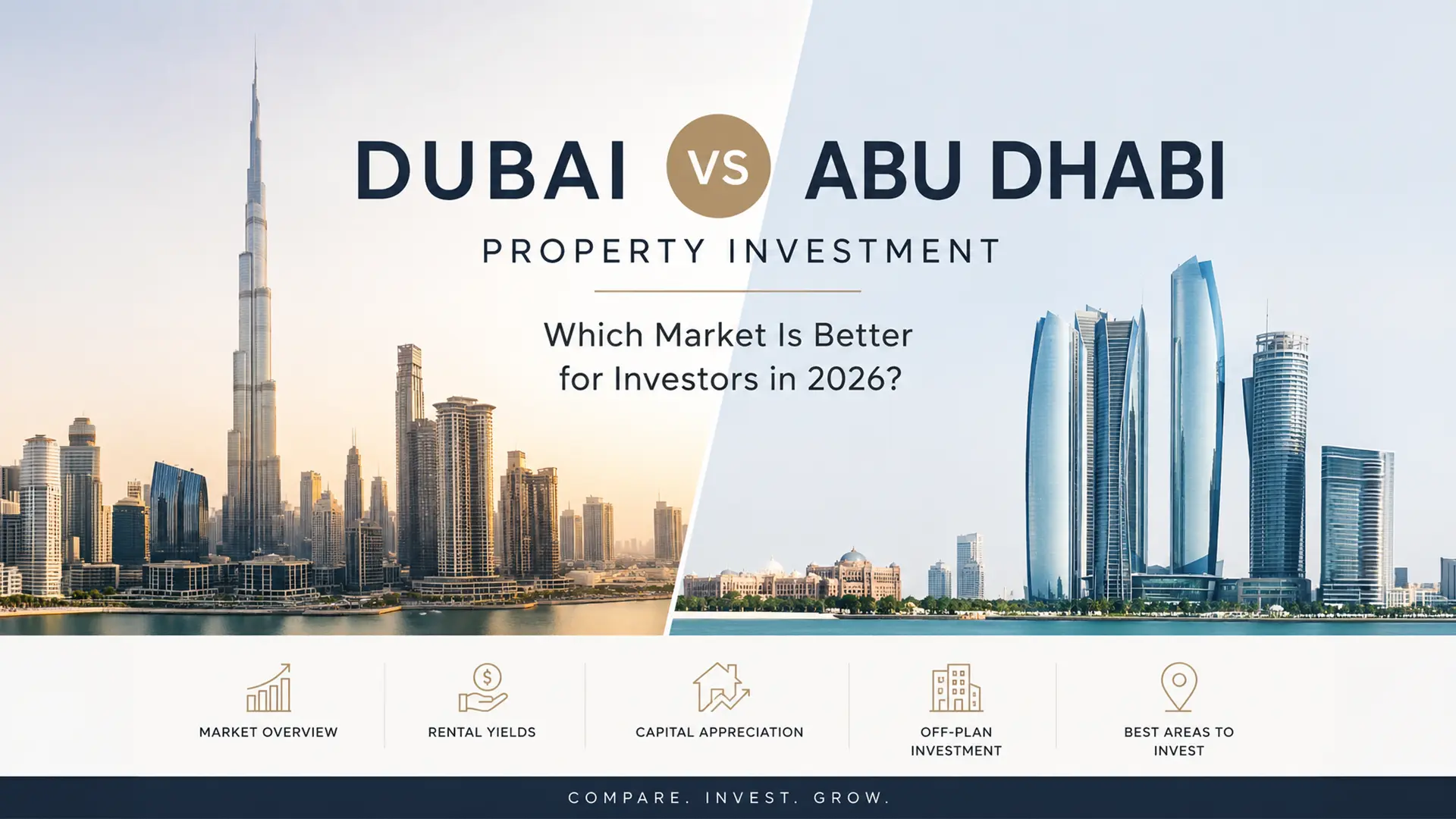
Dubai vs Abu Dhabi Property Investment: Which Market Is Better for Investors in 2026?
The UAE property market continues to attract global investors, but one question remains common among buyers: should you invest in Dubai or Abu Dhabi? Both cities offer strong real estate opportunities, but they are not the same market. Dubai is known for high transaction activity, global demand, off-plan launches, strong rental yields, and faster capital movement. Abu Dhabi, on the other hand, is becoming increasingly attractive for investors looking for stability, limited supply, premium master communities, and long-term value.
For investors, the decision between Dubai property investment and Abu Dhabi property investment depends on your budget, risk appetite, rental income expectations, and long-term goals. Some buyers want fast appreciation and high liquidity. Others want secure, lifestyle-driven communities with lower volatility. Understanding the difference between both markets can help investors make better decisions in 2026.
Dubai’s real estate market started 2026 with strong momentum. According to Dubai Land Department data, Dubai recorded AED 252 billion in total real estate transactions in Q1 2026, up 31% year-on-year, with 60,303 transactions recorded during the quarter. Abu Dhabi also delivered record performance, with the Abu Dhabi Real Estate Centre reporting AED 66 billion in real estate transactions in Q1 2026, a 160.7% increase and the emirate’s highest quarterly performance on record.
This shows that both markets are active, but they are growing in different ways.
Dubai Property Investment: High Demand, High Liquidity and Global Appeal
Dubai is usually the first choice for international property investors entering the UAE market. The city has built a global reputation for luxury developments, tax-friendly investment, strong infrastructure, business opportunities, and a highly active rental market.
One of Dubai’s biggest advantages is liquidity. Investors can usually buy and sell faster in Dubai compared with Abu Dhabi because the market has a larger buyer pool. Dubai attracts end-users, residents, international investors, short-term rental operators, and high-net-worth buyers. This makes the market more active and gives investors more exit options.
Dubai is also highly attractive for off-plan property investment. Developers continue to launch new communities with flexible payment plans, post-handover options, and branded lifestyle concepts. For investors with smaller entry budgets, Dubai offers more variety, from studios and one-bedroom apartments to waterfront homes, townhouses, and branded residences.
Rental yields remain another major strength. As of April 2026, Dubai’s average rental yield was around 6.68%, with apartments averaging 7.15% and villas/townhouses around 4.98%, based on Property Monitor data cited by Engel & Völkers. In some mid-market communities, yields can be even stronger depending on entry price, rental demand, and property type.
Popular investor areas in Dubai include Jumeirah Village Circle, Dubai South, Business Bay, Dubai Marina, Downtown Dubai, Dubai Hills Estate, Arjan, Dubai Creek Harbour, and Dubai Islands. Each location serves a different investment purpose. JVC and Arjan are often yield-focused. Downtown and Dubai Marina are more established and liquid. Dubai South is a long-term growth play linked to infrastructure, aviation, logistics, and population expansion.
Dubai’s biggest opportunity is growth. The city continues to expand through infrastructure, tourism, population growth, and business migration. However, the biggest risk is also linked to growth: supply. Several market reports have pointed to potential oversupply pressure in Dubai as many new units are expected to be delivered between 2026 and 2028. This does not mean the market is weak, but it means investors need to be more selective.
In Dubai, buying anything in any location is no longer enough. Investors need to focus on developer quality, handover timeline, payment plan, community demand, rental audience, service charges, and future supply in the same area.
Abu Dhabi Property Investment: Stability, Limited Supply and Long-Term Value
Abu Dhabi’s property market has traditionally been more stable and less speculative than Dubai. While Dubai is faster and more globally visible, Abu Dhabi offers a more controlled investment environment. Supply is generally more limited, master communities are carefully planned, and the buyer profile is often more end-user driven.
In recent years, Abu Dhabi has become more attractive to foreign investors due to new freehold zones, major lifestyle developments, cultural destinations, waterfront communities, and stronger demand from both residents and international buyers. According to ADREC data cited by Engel & Völkers, Abu Dhabi recorded AED 142 billion in total real estate transactions in 2025, representing 44% year-on-year growth, while residential transactions reached AED 76 billion, up 67% from 2024.
The strongest Abu Dhabi investment areas include Saadiyat Island, Yas Island, Al Reem Island, Al Raha Beach, Hudayriyat Island, Masdar City, and Zayed City. These areas attract different types of investors. Saadiyat is known for luxury, beachfront living, museums, and premium capital growth. Yas Island offers entertainment, tourism, branded communities, and rental demand. Al Reem Island is more central and rental-driven. Hudayriyat is emerging as a premium lifestyle and long-term growth destination.
Abu Dhabi’s biggest advantage is controlled supply. Compared with Dubai, Abu Dhabi does not launch at the same speed or volume. This can support long-term value because fewer competing units enter the market at once. For investors who prefer stability over fast flipping, Abu Dhabi can be a strong choice.
Rental yields in Abu Dhabi can also be attractive, especially in well-connected apartment communities. Some 2026 market estimates show strong net yields in areas such as Al Reem Island and Yas Island, with one-bedroom and two-bedroom units performing well due to professional tenant demand and lifestyle appeal.
Another major factor is lifestyle. Abu Dhabi is building a strong identity around cultural districts, waterfront living, family communities, leisure islands, and premium low-density developments. Projects on Saadiyat, Yas, and Hudayriyat are not just residential communities; they are lifestyle destinations. This makes Abu Dhabi especially attractive for long-term investors and end-users who want quality of life as well as capital appreciation.
Dubai vs Abu Dhabi: Rental Yield Comparison
For investors focused mainly on rental income, Dubai often gives more variety and stronger short-term rental opportunities. Areas such as JVC, Dubai Marina, Business Bay, Downtown Dubai, and Dubai South can attract tenants from different income groups, including professionals, families, tourists, and business travellers.
Dubai also has a more developed short-term rental market. This can help investors generate higher income in tourism-heavy locations. However, short-term rentals require active management, furnishing, maintenance, pricing strategy, and compliance. It is not a passive investment unless handled by a professional operator.
Abu Dhabi rental income is generally more stable. The tenant base is often made up of long-term residents, government employees, corporate professionals, families, and executives. Investors may not always see the same short-term rental upside as Dubai, but they may benefit from more predictable occupancy in the right communities.
For yield-focused investors, Dubai may be stronger. For stable rental income with lower volatility, Abu Dhabi is highly competitive.
Dubai vs Abu Dhabi: Capital Appreciation
Dubai has historically offered faster capital appreciation during growth cycles. When demand rises, prices in Dubai can move quickly, especially in prime and emerging areas. Investors who enter early in the right off-plan project can benefit from price increases before handover.
However, this also means Dubai can be more sensitive to supply, investor sentiment, and global market changes. A location with too many similar handovers may face rental pressure or slower resale demand.
Abu Dhabi capital appreciation is usually slower but more stable. Premium locations such as Saadiyat Island, Yas Island, Al Reem Island, and Hudayriyat Island have strong long-term fundamentals because supply is more limited and communities are planned around lifestyle, culture, leisure, and waterfront living.
For short-to-medium-term appreciation, Dubai may offer more opportunities. For long-term capital preservation and premium growth, Abu Dhabi can be a safer choice.
Dubai vs Abu Dhabi: Off-Plan Investment
Dubai is one of the most active off-plan markets in the region. Investors can find projects across almost every budget range, from affordable studios to ultra-luxury waterfront mansions. Flexible payment plans are a major reason buyers choose Dubai. Some developers offer post-handover payment plans, low booking amounts, and extended construction-linked schedules.
This makes Dubai attractive for investors who want lower upfront capital. However, investors must carefully check developer reputation, escrow status, handover history, location demand, and resale restrictions.
Abu Dhabi’s off-plan market is smaller but increasingly strong. Developers such as Aldar, Modon, Reportage, Bloom, and others are bringing more communities to the market, especially in lifestyle and waterfront zones. Abu Dhabi off-plan projects may have less speculative flipping activity compared with Dubai, which can make the market more end-user focused.
For investors who want more choice and payment-plan flexibility, Dubai is stronger. For investors who want limited-supply master communities, Abu Dhabi is very attractive.
Dubai vs Abu Dhabi: Buyer Profile
Dubai attracts a wider international investor base. Buyers come from Europe, India, China, Russia, the GCC, Africa, and other regions. Many buyers see Dubai as a global investment hub, lifestyle destination, and tax-efficient base. This broad demand supports liquidity.
Abu Dhabi attracts more long-term residents, UAE-based professionals, high-net-worth buyers, and investors who prefer stable communities. International demand is growing, especially in freehold lifestyle destinations, but the market is still more selective compared with Dubai.
This difference matters because buyer demand affects resale. In Dubai, the resale pool is often larger. In Abu Dhabi, the buyer pool may be smaller but more serious and end-user driven.
Which City Is Better for Investors?
There is no single answer. The better investment depends on your strategy.
Choose Dubai property investment if you want higher liquidity, more off-plan options, stronger short-term rental potential, flexible payment plans, and faster capital movement. Dubai is ideal for investors who are comfortable with a more active market and want access to a large international buyer and tenant base.
Choose Abu Dhabi property investment if you want stability, limited supply, premium master communities, long-term value, and a more end-user-driven market. Abu Dhabi is ideal for investors looking for lower volatility and strong lifestyle-led growth.
For many serious investors, the best strategy is not Dubai or Abu Dhabi. It is Dubai and Abu Dhabi. Dubai can offer higher liquidity and rental yield, while Abu Dhabi can offer stability and long-term capital preservation. A balanced UAE property portfolio can include both.
Final Verdict
Dubai remains the UAE’s most active and globally recognised real estate investment market. It offers strong rental yields, high liquidity, diverse property options, and powerful international demand. For investors looking for faster movement, flexible payment plans, and strong resale potential, Dubai remains one of the best property markets in the region.
Abu Dhabi is becoming one of the most important long-term investment markets in the UAE. With record transaction growth, limited supply, premium islands, waterfront communities, and strong government-backed development, the capital is gaining serious investor attention.
In 2026, Dubai is better for investors who want speed, liquidity, and higher rental activity. Abu Dhabi is better for investors who want stability, exclusivity, and long-term value. The smartest choice depends on your budget, goals, and preferred level of risk.
For investors planning to enter the UAE real estate market, both cities offer strong opportunities. The key is not just choosing the city. The real success comes from choosing the right community, the right developer, the right unit, and the right entry price. Planning to invest in Dubai or Abu Dhabi? Speak with NUVÉ Properties to compare the right communities, developers, payment plans, and investment options based on your budget.