Dubai’s Soft Mobility Expansion: What It Means for Real Estate Across 25 Communities
Dubai’s soft mobility plan will connect 25 communities and 63 transport stations by 2030. Explore what it could mean for property demand and value.
Dubai’s Soft Mobility Expansion Could Reshape Real Estate Demand Across 25 Communities
Dubai’s next major transport upgrade is not centred on a new motorway or large interchange. It is focused on the smaller part of the daily journey that often determines whether a neighbourhood feels genuinely convenient: the walk from home to the Metro, the cycle from an office to a bus station, or the short e-scooter trip between a residential building and a nearby destination.
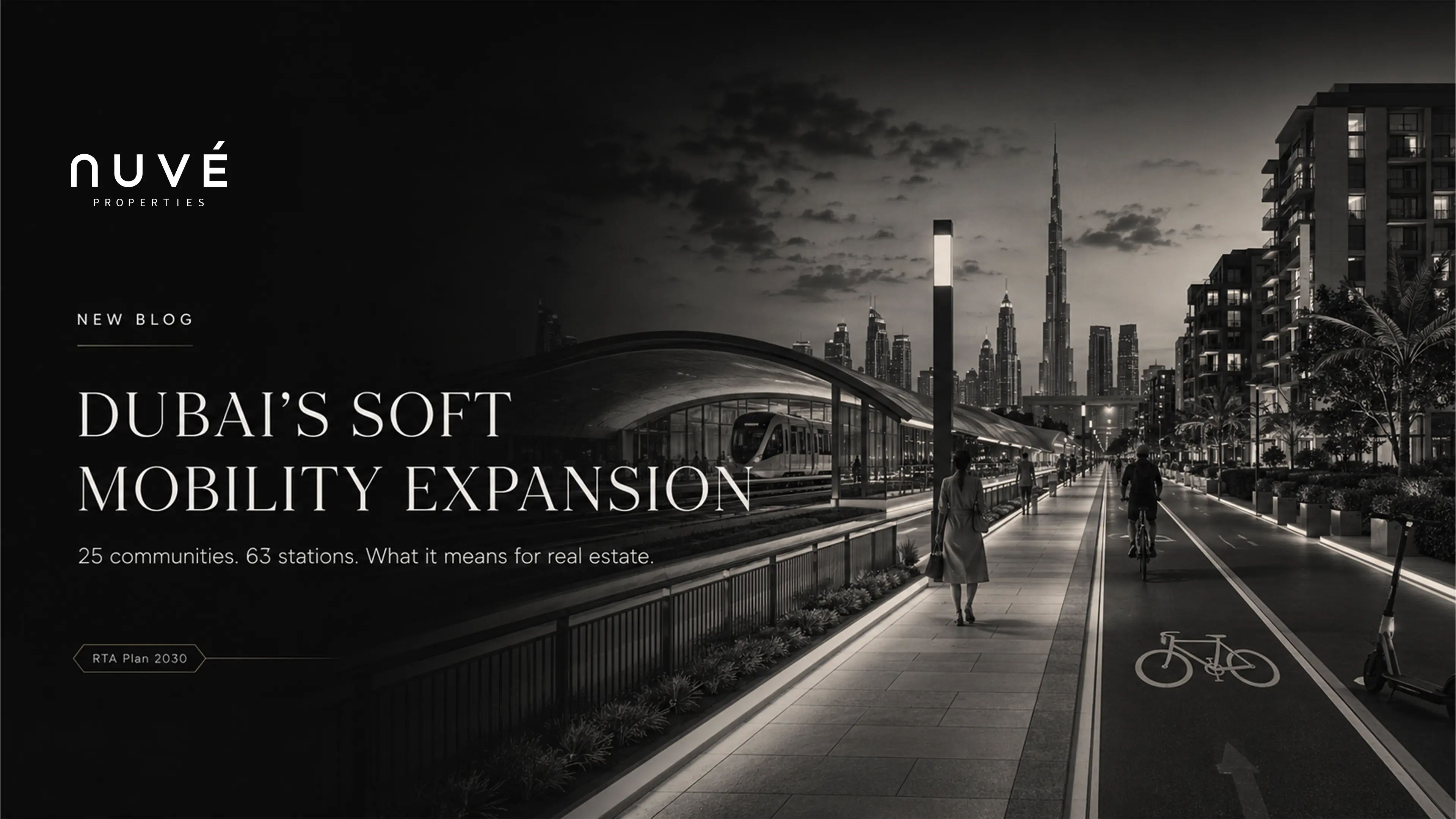
The Roads and Transport Authority has approved a five-year plan to expand Dubai’s soft mobility network across 25 residential communities and improve access around 63 Metro and bus stations by 2030. The programme will introduce or upgrade pedestrian paths, cycling tracks, shaded walkways, safer crossings, bicycle parking, pick-up and drop-off areas and shared mobility facilities.
For Dubai’s property market, this is more than a transport story. It reflects a wider change in how buyers and tenants judge location. Road access will remain important, but daily convenience is increasingly measured by the quality of the entire journey outside the front door. A home with practical access to public transport, shops, offices and community facilities can become more attractive even when it is not in the city’s most expensive district.
A More Connected Definition of Location
Dubai property marketing often relies on driving times to Downtown, Dubai Marina, the airport or a business district. Those figures are useful, but they do not explain how comfortably a resident can move through the city.
A building may be close to a Metro station on a map, yet the route could involve narrow pavements, unshaded sections or difficult road crossings. In practical terms, that station may feel much farther away than the distance suggests.
Soft mobility infrastructure addresses this gap. When the path between a property and a transport station becomes wider, safer, shaded and easier to navigate, the functional location of that property improves. The building itself has not moved, but its connection to the rest of Dubai becomes more usable.
For investors, the quality of access outside a development can be almost as important as the amenities inside it. A well-planned public realm can improve competitiveness and widen the tenant pool.
What the RTA Plan Includes
The initiative is designed to improve first- and last-mile travel, meaning the beginning and end of a journey made by public transport. The RTA plans to extend soft mobility infrastructure to 25 additional residential communities, taking the total number of targeted areas to 34 by 2030. Areas around 63 public transport stations will also be upgraded.
Improvements include walking and cycling routes, safer crossings, shaded paths, rest areas, landscaping, bicycle parking, pick-up zones and shared mobility facilities. Accessibility features for People of Determination are also expected.
Work is already progressing in Dubai Marina, Naif, Al Rigga, Al Murar and Al Muraqqabat. Similar upgrades have previously been completed in Al Mankhool, Al Qusais, Al Karama, Al Barsha 1, Al Barsha 2, Al Khawaneej 2, Hor Al Anz, Abu Hail and Al Souk Al Kabeer.
Future areas are expected to be selected according to population density, public transport use, land use, existing infrastructure and development plans. This is especially relevant to real estate because it connects mobility spending with where people live, work and are likely to move in the future.
Why First- and Last-Mile Access Matters
Residents experience a neighbourhood through daily routines. A safe, comfortable route to public transport removes friction from those routines.
Shaded walkways make short distances more manageable. Clear crossings improve safety. Cycling tracks reduce conflict between riders, pedestrians and vehicles. Dedicated pick-up areas can make taxi and ride-hailing connections more orderly. Bicycle and e-scooter parking can help residents combine several forms of transport during one journey.
These details can influence housing decisions, especially among professionals, younger residents and households that prefer not to depend on a second car. Families also benefit when routes connect homes to schools, parks, clinics and shops.
Dubai’s mobility figures show that these habits are already substantial. In 2025, the city recorded 342 million pedestrian journeys, 57.3 million cycling trips and 39.6 million e-scooter trips. The infrastructure plan is responding to established behaviour rather than trying to create demand from zero.
Potential Impact on Rental Demand
Rental demand often improves when a property solves a practical lifestyle need. The RTA’s expansion may strengthen communities where station access exists but is not yet comfortable.
For tenants, commuting cost and time can affect how much value they attach to a home. A slightly smaller apartment with reliable Metro access may be preferable to a larger unit that requires daily taxi trips or long periods in traffic. Better walking and cycling links can make that trade-off clearer.
Properties near upgraded stations may appeal to non-drivers, cost-conscious households and professionals working across the city. Secure bicycle storage and direct pedestrian connections may add further appeal.
This does not mean every property near a new walkway will automatically command higher rent. Building quality, unit condition, supply, service charges and overall location will remain decisive. Improved connectivity is a supporting factor, particularly when tenants compare similar properties within the same price range.
What It Could Mean for Property Values
Transport infrastructure can support property values, but the effect depends on connection quality, property type, surrounding uses and whether the upgrade solves a real problem.
The clearest impact may be seen in buildings within practical walking or cycling distance of Metro and bus stations. If an upgraded route shortens the perceived journey, improves safety and reduces dependence on cars, the address becomes more functional.
For end users, this improves daily life. For investors and landlords, it can broaden buyer demand and strengthen a property’s position in listings.
The larger opportunity may be in established districts. New master communities often include landscaped paths and mobility planning from the beginning. Older, denser neighbourhoods may already have strong locations, active streets and public transport but require better connections. Targeted upgrades can help them compete more effectively without complete redevelopment.
Established Communities May Gain New Attention
Dubai Marina already has strong lifestyle appeal, a dense residential population and access to the Metro and Tram. Improving pedestrian and cycling movement can reinforce its position as a community where residents complete more journeys without a car.
In Al Rigga, Naif, Al Murar and Al Muraqqabat, better walking conditions could support both residents and local businesses across established mixed-use streets.
For investors, this is a reminder not to judge older communities only by the age of their buildings. Public investment in streets, crossings, station access and landscaping can change how a district performs. A mature location with improving infrastructure may offer existing occupancy, established amenities and the possibility of gradual neighbourhood enhancement.
Property selection remains essential. Investors should assess building maintenance, ownership costs, layouts, parking, tenant profile and nearby supply. Mobility improvements should form one part of the investment case, not replace full due diligence.
A Possible Boost for Retail and Offices
Soft mobility can also affect commercial real estate. Pedestrian-friendly routes may increase visibility and passing traffic for cafés, convenience stores, pharmacies, salons and other daily-use businesses. When residents can comfortably walk between homes, stations and retail areas, more local spending may remain within the neighbourhood.
A shaded route with safe crossings can create more useful footfall than a short but uncomfortable connection. Retail along natural movement corridors may benefit.
Office properties may also benefit as businesses increasingly consider commute convenience. A Metro-adjacent office with a safe station connection is more useful than proximity alone.
Landlords and asset managers should look beyond the building boundary. Entrances, signage, bicycle parking, drop-off management and the connection between the lobby and public route can affect how well a property captures the benefit.
Supporting Dubai’s 20-Minute City Ambition
The programme aligns with the Dubai 2040 Urban Master Plan and its aim to create more connected, people-centred communities. One of the plan’s major ideas is the 20-minute city, where residents can reach most daily needs and destinations within a short walk or bicycle journey, while more people live close to mass transit.
For real estate, this favours integrated neighbourhoods that combine homes, employment, schools, healthcare, retail, leisure and transport within a practical network.
This does not remove the importance of cars in Dubai. The city will continue to rely on roads, taxis and private vehicles. The change is that residents may have more realistic choices. A journey could involve walking to the Metro, cycling to work, using an e-scooter for the final section or driving only when necessary.
Properties that support this flexibility may become increasingly desirable. Buyers are not simply purchasing square footage; they are purchasing access to a daily lifestyle. The street outside the building, the route to the station and nearby services are part of that lifestyle.
What Buyers and Investors Should Look For
Buyers should not make decisions from headlines alone. Exact locations, timing and scope will matter, so investors should study how a property connects to the transport network in practice.
A useful assessment should include the real walking time to the nearest station, the condition of the route, major crossings, shade, lighting, pavement width and accessibility. Buyers should also consider whether the station connects efficiently to employment areas and whether local services can be reached without driving.
The building itself also matters. Secure access, bicycle storage, suitable parking, efficient drop-off space and maintained common areas can strengthen the value of the surrounding network. In off-plan developments, buyers should review the master plan carefully and distinguish confirmed public infrastructure from marketing illustrations.
Investors should not assume that the closest property will always perform best. A building directly beside a station may experience noise, congestion or heavy footfall, while one five to ten minutes away may offer a better balance of accessibility and residential comfort.
A Long-Term Improvement to Dubai’s Property Proposition
Dubai’s real estate appeal has always been connected to infrastructure. Airports, highways, Metro lines, business districts and master-planned communities have shaped where people live and invest. The next phase is becoming more detailed. It is about connecting those major systems to the front doors of homes, offices and shops.
The RTA’s plan to improve soft mobility across 25 communities and 63 public transport stations could make several neighbourhoods easier to live in and more competitive. The greatest benefit may not come through immediate price increases. It may appear through stronger tenant interest, lower dependence on cars, better retail activity, improved public spaces and a more complete residential experience.
For buyers and investors, connectivity should be measured at street level. A Metro station shown on a map is only part of the story. The route to that station, the comfort of the journey and the services available along the way can be just as important.
As Dubai works towards a more integrated city by 2030, real estate decisions will increasingly favour communities that connect people not only to major destinations, but also to everyday life. That is where soft mobility may have its most lasting effect.
At NUVÉ Properties, we evaluate opportunities through more than price and location labels. We consider infrastructure, community planning, transport access, future supply and the practical experience a property can offer its residents. For guidance on selecting a Dubai property aligned with long-term urban growth, speak with our team. Our advisory approach considers how infrastructure decisions today may influence liveability, rental demand and resale potential over the years ahead.